Before anything is harvested, Dr. Vézina draws the beard line, the cheek line and the moustache flow directly on you — sitting up, in natural light, with a mirror in your hand. Nothing is decided while you are lying down. Most procedures fall between a few hundred grafts and just over two thousand, depending on how much of the face is being built.
The beard that never
quite arrived.
Patchy cheeks. A gap along the jaw. A moustache that never joined the chin. Facial hair is largely genetic — no amount of waiting changes it. A beard transplant moves your own permanent hair to where it was always meant to grow.
The Revio
difference.
Every surgical incision in your beard restoration is performed by Dr. Vézina herself — the donor harvesting punches, and the recipient sites that set the direction of every hair in your beard. The non-incisional supporting work — extracting follicles, sorting grafts under microscope, and implanting each follicle into the site Dr. Vézina has created — is performed by our lead technician under her direct oversight.
A beard is judged closer than any other restoration. It is seen at conversational distance, in daylight, by people who have known your face for years. That is the standard the work has to meet.
Why the angle
decides it.
Scalp hair leaves the skin at roughly 45 degrees. Beard hair lies almost flat against the face — and its direction changes across every zone of it. Placed at scalp angles, a beard reads as wrong long before anyone can say why.
Dr. Vézina maps that flow before a single site is made:
- The cheek line
Hair sweeps downward and slightly outward. The line itself is drawn to your bone structure, not to a template.
- The jaw and chin
Direction turns as it follows the jaw, steepening toward the chin where growth is naturally densest.
- The moustache
The most demanding zone. Hair angles sharply downward toward the lip, and an error here is visible in every photograph you appear in.
- Sideburns and the join
Where beard meets scalp, two different hair characters have to be blended so the transition disappears.
Density can be added in a later session. Direction cannot be corrected without removing and replacing grafts — which is why it is settled first.
Why a general
clinic isn't enough.
A beard is not a small scalp. The donor hair behaves differently, the recipient skin behaves differently, and the result is inspected at a distance no scalp result ever is.
- Angle of entry.
Scalp sites are made at roughly 45°. Beard sites must sit nearly flat to the skin. A clinic running one protocol for both produces a beard that stands away from the face.
- Follicle selection.
A natural beard line is built from single-hair follicles; density behind it can carry two-hair grafts. That sorting is done under high-power microscope, not by eye.
- Facial skin is not scalp.
The face is mobile, soft, and highly vascular. Site depth and spacing have to account for that, or grafts are lost in the first days.
- A finite donor supply.
Every graft in your beard comes out of your scalp. Over-harvesting to build density trades one problem for another — which is why the plan is drawn against what your donor area can actually afford.
Who this
is for.
Beard restoration is a permanent answer for facial hair that never filled in — or that was interrupted.
- ✓Patchy or asymmetric growth that never developed.
- ✓Thin or absent cheek lines, goatee, moustache, or sideburns.
- ✓Scarring from acne, surgery, injury, or cleft repair.
- ✓Facial hair construction as part of gender-affirming care.
- ✓Regret after laser hair removal or electrolysis.
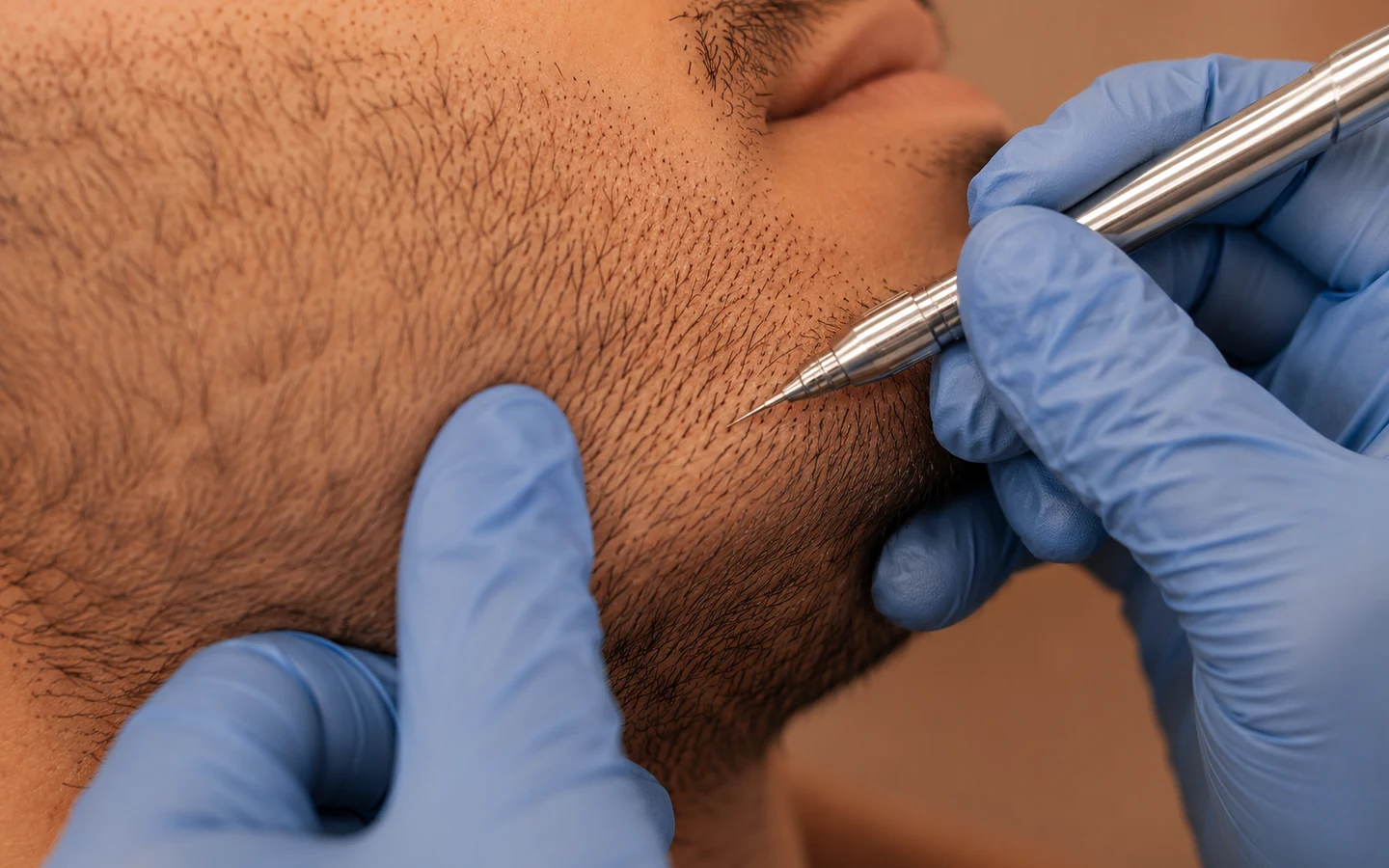 Placed one follicle at a time
Your procedure
with Dr. Vézina.
Four stages, one day, one physician.
Grafts are taken by FUE from the safe donor zone at the back and sides of the scalp — hair unaffected by the hormone behind pattern baldness, which keeps that resistance once moved. Dr. Vézina performs every harvesting punch personally. Under her oversight, the lead technician extracts each follicle and sorts the grafts under high-power microscope.
Every site is created by Dr. Vézina, at the angle and direction that zone of your face requires, using the thinnest specialized blades. This is the step that decides whether the result reads as a beard or as a procedure.
Each follicle is placed by hand into the site Dr. Vézina has already angled — single hairs along the visible line, denser grafts behind it, under magnification throughout.
Every incision in this procedure is made by Dr. Vézina. This is the Revio physician-only guarantee.
Recovery &
results.
- The first ten days.
Small crusts form at each graft and across the donor area, and resolve within roughly seven to ten days. Most patients are comfortable in public around day ten.
- Shaving, after two weeks.
Leave the area alone for the first fourteen days. After that, you can shave and trim normally.
- Shedding is expected.
Transplanted hairs shed between weeks two and four. The follicle stays; only the shaft is lost. This is the growth cycle resetting, not a failed graft.
- Growth, then density.
New growth begins around months three to four. Density builds through months six to nine, and the final result is judged at twelve months.
- Permanent.
Transplanted follicles keep the characteristics of the donor site, so they continue to grow — and to need trimming — for life.
Revio precision vs.
standard practice.
| Feature | Revio | Standard clinics |
|---|---|---|
| Surgical incisions performed by | Dr. Vézina, every one. | Technicians, often without physician oversight. |
| Donor area | Safe zone of the scalp, harvested by FUE. | Whatever extracts fastest. |
| Graft preparation | Sorted under high-power microscope; single hairs along the visible line. | Mixed grafts placed as-is — a blunt, uniform line. |
| Angle of entry | Nearly flat to the face, mapped zone by zone. | Scalp angles — hair stands away from the skin. |
| Patients per day | One. | Several, in parallel. |
| Follow-up | 1 week, 1 month, 1 year — included. | Often ends when you leave the clinic. |
Frequently asked
questions.
- Where does the hair come from?
The safe donor zone at the back and sides of your scalp. That hair is unaffected by the hormone responsible for pattern baldness, and it keeps that resistance after it is moved — which is why a transplanted beard is permanent. Revio harvests from the scalp only.
- How many grafts will I need?
Anywhere from a few hundred to just over two thousand, depending on how much of the face is being built and the density you want. The number is set at your evaluation, not over the phone.
- Who performs the surgery at Revio?
Dr. Vézina personally performs every surgical incision: the donor harvesting punches and the recipient sites that set every angle. The non-incisional supporting work — extraction, microscope sorting, and implantation — is performed by our lead technician under her direct oversight. This is the legally required model in Canada.
- When can I shave again?
After two weeks. Before that, leave the area alone entirely.
- When will I see the final result?
Transplanted hairs shed between weeks two and four, which is normal. New growth starts around month three or four, density builds through months six to nine, and the result is assessed at twelve months.
- Will it look patchy while it grows in?
Growth is not uniform at first — hairs arrive at different rates through the middle months, and that evens out. Judging the result before twelve months is judging it early.
- Is it painful?
The procedure is performed under local anesthesia, across a single day.
- Can it cover a scar?
Often, yes — hair can be placed into and around scar tissue to break up the line. Scarred skin has a reduced blood supply, so graft survival there is less predictable. Dr. Vézina will tell you honestly what to expect before you decide.
Begin in private.
A first consultation with Dr. Vézina is a conversation — unhurried, confidential, and free of pressure. We will look at your face, your goals, and your medical context together, and you will leave with clarity, not a sales pitch.